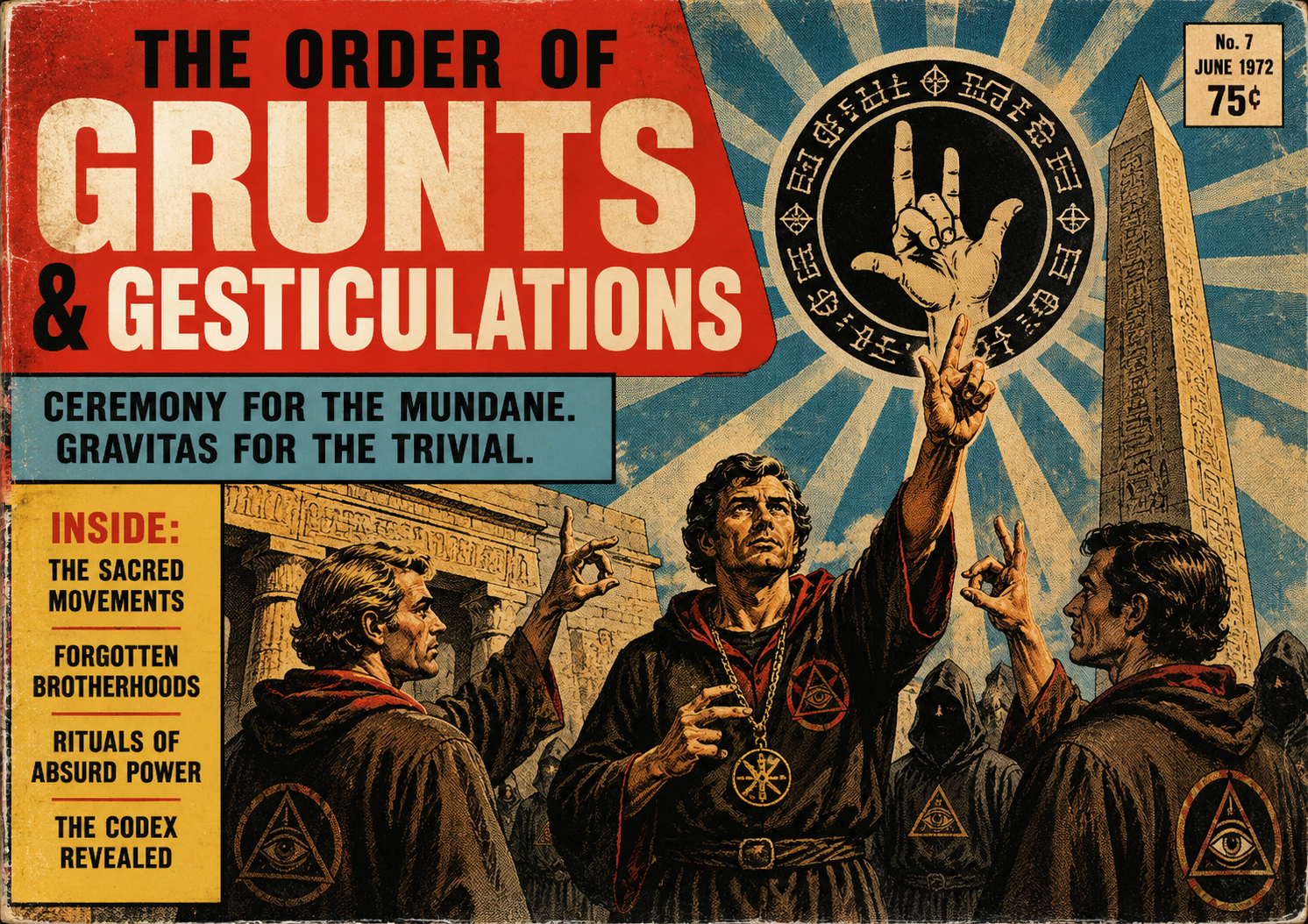
 Order of Grunts and Gesticulations Ancient Brotherhood. Questionable Purpose.
Related Articles



In the sense of The Order of Grunts and Gesticulations, a benevolent act is not merely “being nice.” That is too thin. That is greeting-card morality. Useful, perhaps, but prone to glitter.
A benevolent act, in the Order’s meaning, is a practical good done for another person without needing applause, leverage, or ownership over the result.
It is help without a hook.
It is not charity as performance. It is not the banker’s banquet, the corporate donation plaque, or the businessman shaking hands in front of a photographer while quietly invoicing the village through a holding company. The Order would regard that as ceremonial benevolence: impressive tablecloths, doubtful motives.
The real benevolent act is usually smaller, quieter, and more useful.
It is a man showing a younger man how to change a tyre, read a payslip, speak to a difficult employer, save money, avoid a bad loan, hold his temper, or take pride in work that no one important will ever see.
It is the tradesman who teaches properly instead of guarding knowledge like a dragon sitting on a socket set.
It is the father who apologises without making a speech.
It is the older bloke who says, “Don’t finance that car, you idiot,” and thereby saves a young man five years of ritualised poverty.
In the Codex, meaning is carried through gestures, nods, work, and presence rather than grand declarations. The Codex describes this kind of belonging as something outside permission, paperwork, and prestige, preserved by ordinary men through handshakes, worksite nods, shared labour, and mutual understanding. That gives us the heart of the matter: benevolence in the Order is not an announcement of virtue. It is a transfer of steadiness.
A benevolent act should do at least one of these things:
It should lessen another man’s burden.
It should increase his competence.
It should protect his dignity.
It should help him stand more firmly in the world.
That last part matters. The Order is not built around pity. Pity looks down. Benevolence stands beside.
So, in Order terms, benevolence is not rescuing a man so he remains dependent on you. It is helping him become harder to exploit. It is passing on skill, judgment, caution, humour, and enough quiet encouragement that he can continue without needing to kneel before anyone’s grand desk.
This is where the Order separates itself from elite benevolent societies. Many old societies did good, yes, but often through status, money, patronage, and velvet chairs occupied by men who never changed their own oil. The Order’s version is more grounded: brotherhood through practical usefulness. The earlier charter work for the Order placed emphasis on working-class dignity, practical knowledge, civic duty, generosity, and the preservation of skill. That is benevolence with dirt under its nails.
A simple definition would be:
A benevolent act is any deliberate deed that strengthens another person without weakening their dignity.
A more Order-flavoured Grunts and Gesticulations’ version:
A Benevolent Act is the sacred interference by which one man quietly prevents another from being crushed by ignorance, loneliness, bad advice, cheap tools, or paperwork.
And a more formal version:
Within the Order benevolence is understood as useful goodwill: the giving of time, skill, attention, protection, correction, or material aid in a manner that preserves the recipient’s dignity and strengthens his capacity to stand on his own.
That gives the Order substance. It says: we are not here merely to grunt in cloaks and invent gestures near suspicious candles. Though, naturally, that remains available on Thursdays.
The benevolent act is the moral unit of the Order. Not the slogan. Not the emblem. Not the rank. The act.
A man may wear the badge and still do nothing. Another may never hear of the Order and yet live its principles better than the full Council of Important Mutterers.
The Order would recognise the second man first.