 Order of Grunts and Gesticulations Ancient Brotherhood. Questionable Purpose.
Related Articles

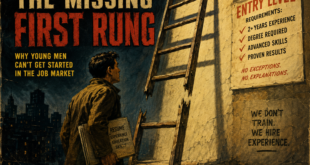

There’s a particular insult to being told the job market is “strong” while you’re on your third application portal that demands you retype your résumé—again—into fifteen tiny boxes that cannot parse dates correctly. The economy, you’re informed, is thriving. Your inbox, meanwhile, is a mausoleum of polite auto-rejections and one cheery email inviting you to “join our talent community,” which is corporate for please stop calling.
A growing number of men—especially young men aiming at non-physical, office-based work—are feeling something that isn’t just personal failure or bad luck. The path into white-collar roles has narrowed, the bar has risen, and the “entry-level” label increasingly means “entry-level pay, mid-level experience, senior-level availability.”
This isn’t a conspiracy. It’s a structural shift. And if you want to understand why it feels harder now—why it is harder now—you have to look at what changed about white-collar work itself.
The white‑collar slowdown is real, and it hits the bottom rung first
Over the past couple of years, hiring has cooled in many office-based categories—especially roles that used to be the default landing zone for smart, capable people who were willing to learn on the job: coordinators, analysts, junior marketing roles, generalist ops jobs, early-career tech and business positions.
Workforce data analyses have shown a measurable pullback in white-collar job postings and a flattening of advertised pay. For example, Revelio Labs reported that new job postings for white‑collar roles fell from Q1 2024 to Q1 2025, and that advertised salaries in new white‑collar postings have been flat since mid‑2024—especially for early‑career roles.
That combination—fewer openings and stagnant wages—does something psychologically brutal: it makes the job hunt feel like a personal referendum. But it’s often just math. More applicants per opening, slower hiring cycles, more risk-aversion from employers.
The office job ladder didn’t vanish. It just developed a missing middle, and the first rungs got slick with oil.
Office jobs became “harder” because the work got standardized, tracked, and filtered
Non-physical labor used to mean a human manager could glance at your résumé, talk to you for 20 minutes, and decide you seemed competent enough to figure it out.
Now the process is increasingly industrialized:
- Applicant Tracking Systems (ATS) pre-filter people before a human ever sees them.
- Credential inflation quietly turns “nice-to-have” degrees/certifications into baseline requirements.
- Multi-round interviewing becomes the norm because companies treat hiring like a high-stakes procurement decision rather than a human judgment call.
- Ghost postings and “evergreen roles” keep pipelines full even when hiring is paused.
None of this is targeted at men specifically. But it disproportionately punishes anyone who doesn’t have (a) a degree that maps cleanly to a job title, (b) a network that can pull their application out of the pile, or (c) a portfolio that proves they can do the work without being granted the job first.
That last one is the key. White-collar hiring has shifted from “potential” to “proof.”
Why men feel this squeeze in particular
Men aren’t uniquely incapable of office work. They’re not being “phased out.” But there are a few reasons the current white-collar environment can hit men harder—especially in the early-career phase.
Educational pipeline: more women are arriving with the credential tickets
In the U.S., women ages 25–34 are more likely than men in the same age group to have a bachelor’s degree. Pew Research reports 47% of women vs. 37% of men in that age range holding a bachelor’s degree.
In a labor market where employers increasingly use degrees as a sorting mechanism (even when the job doesn’t truly require one), this matters. Not because degrees guarantee competence, but because they’re an easy checkbox for risk-averse hiring.
If more women hold the checkbox, more women clear the first gate.
The “old deal” broke: many men expected work to be a straightforward trade
Historically, a lot of male identity and social standing has been tied to clear transactions:
- do the work,
- get paid,
- move up.
Modern white-collar work—especially at junior levels—often feels like something else:
- perform competence in meetings,
- signal alignment in written tone,
- demonstrate “executive presence” at age 23,
- accept precarious contracts and “growth opportunities.”
It’s not that men can’t do this. It’s that many men were never told they’d have to.
Participation and pressure: men are still working—just under a different set of expectations
Men remain highly attached to the labor force in prime working ages. In the U.S., the labor force participation rate for men ages 25–54 was about 89.9% (May 2026, seasonally adjusted).
So the story isn’t “men opting out en masse” in the prime-age bracket. The story is that the quality, stability, and accessibility of certain white-collar pathways—especially entry-level—has deteriorated relative to expectations.
AI didn’t “take all the jobs.” It changed what employers think junior workers are for
The uncomfortable truth: a lot of entry-level white-collar roles used to be paid training disguised as productivity.
You were hired partly to do tasks, but partly to become someone who could do harder tasks later.
AI accelerates a shift that was already happening: employers are less willing to pay humans to do routine cognitive work when software can do 60–80% of it instantly (or at least convincingly enough that a manager will pretend it counts).
Research summaries from the Upjohn Institute note that jobs most exposed to AI are clustered in white‑collar, higher‑education roles, and that routine cognitive jobs—especially clerical and administrative roles—are projected to keep shrinking.
In Australia, Deloitte has made similar observations: they identify “AI‑disrupted” occupations and note that impacts may show up first in recruitment (vacancies falling) even before you see large employment drops.
So if you’re a young man trying to get into a “non-physical” job category that’s heavy on routine reporting, basic analysis, scheduling, or templated writing, you’re entering right as employers ask:
“Why do we need a junior person for this?”
That question used to be answered by patience and mentorship. Now it’s answered by software and a hiring freeze.
The DEI explanation: why it feels compelling, and why it’s rarely the whole story
In online spaces, a lot of men reach for a simple explanation: “It’s DEI. They’re hiring everyone else.” The appeal is obvious. It turns a messy, humiliating experience into a clean narrative with villains, rules, and a scoreboard.
But in most labor markets, the bigger drivers of white-collar difficulty are:
- fewer postings (especially in tech/business functions),
- higher credential filtering,
- AI substitution for routine tasks,
- globalization/remote applicant pools,
- cost pressure and risk aversion,
- reduced training budgets.
DEI debates do shape hiring practices in some organizations. Perceptions of fairness matter. And discrimination against any group is not something to shrug off as “the way it is.”
But if you treat DEI as the master key that explains every rejection, you end up fighting a fog machine. You’ll miss the concrete levers that actually improve your odds: proof of work, targeted skill-building, and positioning yourself in parts of the economy that are still paying humans to think.
The modern job market is not a morality play. It’s mostly procurement.
What men can do about it (without joining a country club disguised as a brotherhood)
If the entry-level white-collar ladder is wobbling, the move isn’t despair. The move is to stop trying to be “generally employable” and start being specifically useful.
Here are approaches that consistently work better than mass-applying and hoping:
Build proof-of-work that resembles the job
Not “passion.” Not “potential.” Proof.
- If you want analyst roles: publish 2–3 clean projects (dashboards, case writeups, models).
- If you want marketing: show campaigns, funnels, copy tests, creative iterations, results—even small ones.
- If you want operations: document process improvements, automation scripts, SOPs, and how you think.
Employers trust artifacts more than adjectives.
Aim for “adjacent” roles that still train people
Some fields still build talent because they have to:
- healthcare admin and support functions,
- logistics and supply chain,
- compliance/risk,
- field ops + coordination roles,
- certain government and infrastructure-adjacent roles,
- client-facing roles where humans are still the product (account management, implementation, partnerships).
Not glamorous. Often stable. Usually real.
Learn to work with AI (because your boss already assumes you do)
You don’t need to worship the machine. You need to be fluent enough that your output is faster, cleaner, and more strategic than someone who refuses it.
AI doesn’t eliminate all jobs. It eliminates the excuse for low-leverage work.
Network like a normal person, not a motivational poster
This means:
- 10 conversations, not 10,000 applications.
- Asking smart questions.
- Offering value (a small audit, a quick fix, a short analysis).
- Following up without groveling.
The goal is to become a known quantity in a world drowning in unknown ones.
Closing note, delivered with appropriate ceremony
Men built a lot of institutions. Unfortunately, many of those institutions now require men to pass a series of modern rites involving keyword scanners, six interviews, and a personality assessment written by someone who has never met a person.
The work isn’t getting harder because men became worse. The work is getting harder because “non-physical labor” became more abstract, more filtered, and more automated—while the demand for certainty (and credentials) quietly replaced the demand for raw potential.
Your best response is not outrage. It’s leverage.
And yes: updating your résumé for the ninth time is a ritual. But at least admit what it is—a small act of bureaucracy performed to appease the hiring gods, who have always preferred paperwork to people.